
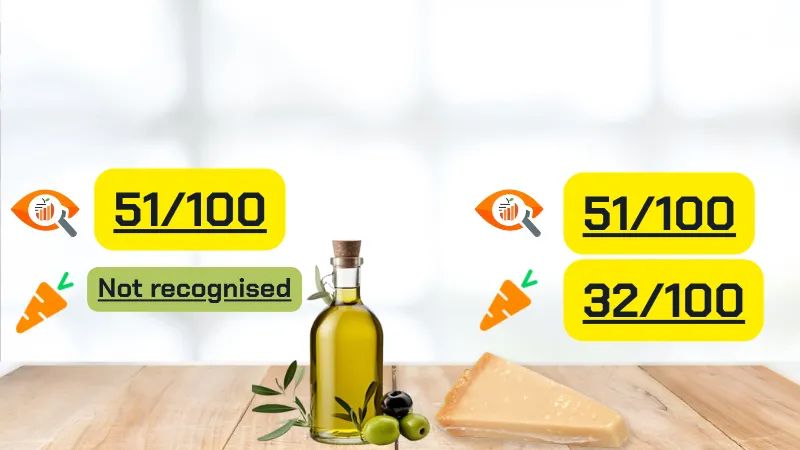
If you've ever used an app like Yuka or glanced at the Nutri-Score "traffic light" on a package, you've likely experienced a moment of confusion. Why does extra virgin olive oil, a cornerstone of the Mediterranean diet, get an orange "C"? And why is Parmesan cheese, a powerhouse of protein and calcium, labeled as "mediocre"?
You're not alone. Searches like "why is Yuka not reliable?" or "Yuka alternatives" are among the most common online. This happens because, while created with good intentions, these scoring systems oversimplify a complex reality: nutrition
In this definitive guide, we won't just criticize. We'll use real-world examples to show you the limits of a one-size-fits-all algorithm and how a personalized, multi-factor analysis—like the one offered by Luminatens—is the only true solution for making genuinely informed food choices that are right for you
How Yuka & Nutri-Score Work (and Where They Go Wrong)
To understand the problem, we first need to understand their methods
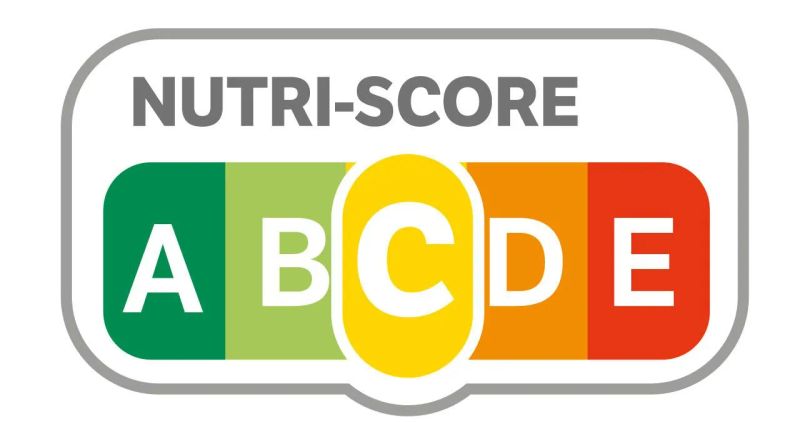
- Nutri-Score This is an algorithm created by the French public health agency. It assigns a score based on a mathematical calculation per 100g of a product. It penalizes calories, sugars, saturated fats, and sodium, while rewarding protein, fiber, and the percentage of fruits/vegetables. The result is a single letter, from A (best) to E (worst)
- Yuka Its popular 0-100 score is based on three pillars
- Nutritional Quality (60% of the score) This is based on a logic very similar to Nutri-Score's
- Presence of Additives (30% of the score) It applies a penalty for each additive considered "risky."
- Organic Certification (10% of the score) It gives a bonus if the product is organic
As you can see the core of Yuka's nutritional rating is, in fact, the Nutri-Score This means they both share the same fundamental flaw: a generalized approach that fails to consider context
Case Study 1: The Parmesan Cheese Paradox
The "Nutriscore Parmesan" search query is a perfect example of this distortion. This Italian excellence typically receives a "C" or "D" from both systems. The reason is simple and blunt: their algorithms only see the raw numbers per 100g and penalize Parmesan for its
- High Saturated Fat content
- High Salt (Sodium) content
What these algorithms completely ignore is
- The Actual Portion Nobody eats 100g of Parmesan in one sitting. A typical portion (10-20g) has a completely different nutritional impact
- The Nutritional Quality The algorithm doesn't "see" that those fats are accompanied by a huge amount of high-value protein calcium (essential for bones), and a lack of sugar
- Your Personal Profile If you follow a ketogenic diet the fats in Parmesan aren't a problem—they're a benefit! But Nutri-Score would give you the same orange letter, misleading you
The Luminatens Analysis: A 360-Degree View
What happens when we analyze the same label with Luminatens, adapting the analysis to different dietary profiles?
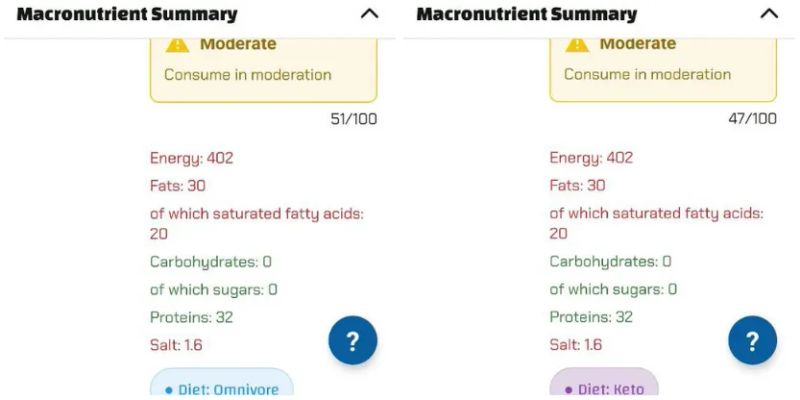
The results are illuminating
- With a Standard Omnivore Diet Luminatens assigns a score of 51/100 ("Consume with moderation"). It recognizes the high protein value but balances the judgment due to saturated fats and salt, which should be monitored in a standard diet
- With a Ketogenic Diet The score adjusts to 47/100 This might seem counterintuitive, but it proves the algorithm's precision. On a keto diet, protein intake is crucial but must be balanced to avoid disrupting ketosis. The high protein content of Parmesan (32g) is therefore slightly penalized in this specific context, while the fats (30g) are perfectly aligned. Here too, the recommendation is "Consume with moderation," but for different, more nuanced reasons
This experiment proves the crucial point a food's value isn't absolute; it's relative to your goals A system that doesn't understand this is bound to be misleading
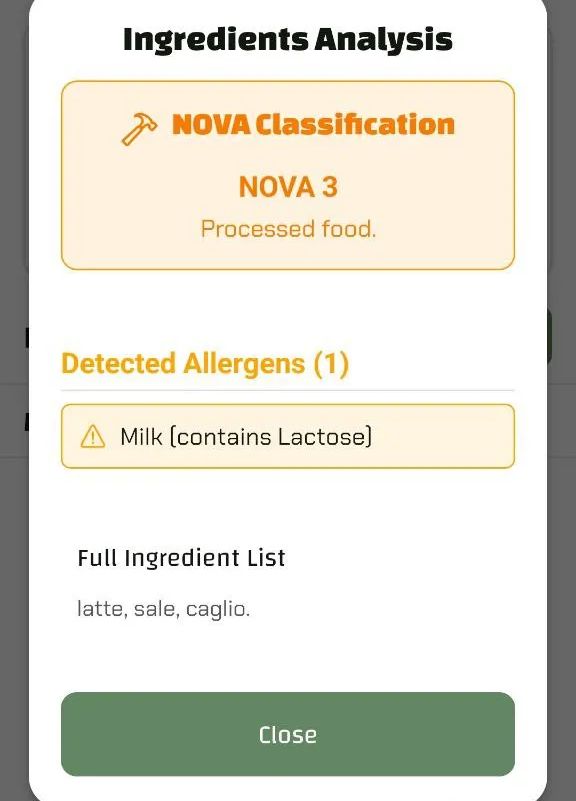
Furthermore, by analysing the ingredients (“milk, salt, rennet”), Luminatens correctly classifies Parmesan as NOVA 3 (Processed Food) not ultra-processed, and detects the milk allergen vital information that a simple traffic light cannot give
Case Study 2: Extra Virgin Olive Oil
Another striking example is extra virgin olive oil, often rated with an orange "C" by Nutri-Score. Why? Again, the algorithm only sees "100% fat" and applies a penalty
We scanned a bottle of extra virgin olive oil with Luminatens
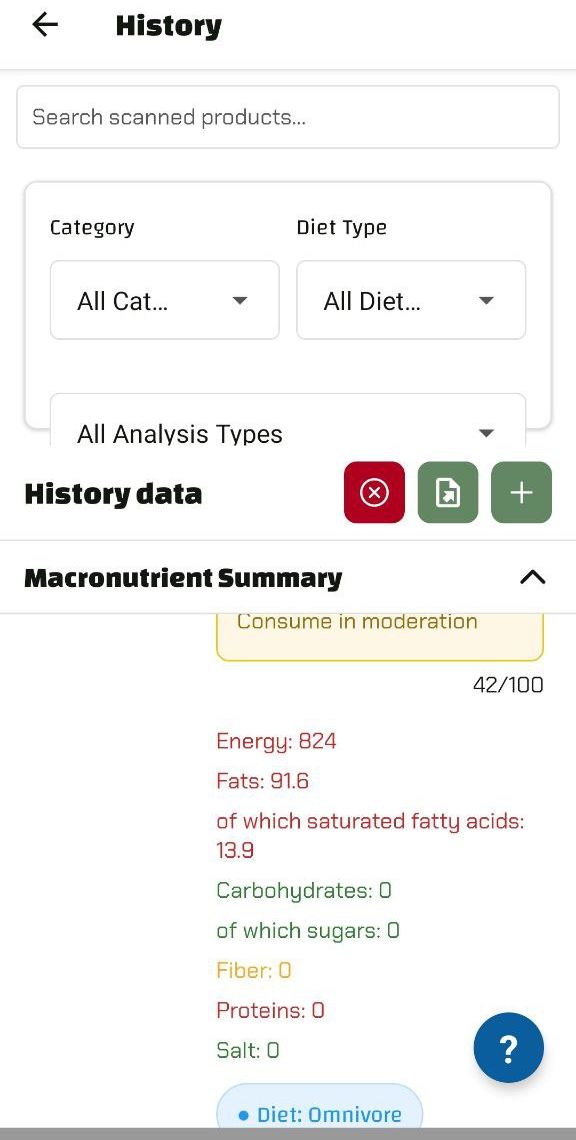
Luminatens assigns a score of 42/100 This isn't an error. The app is communicating a nutritional truth: olive oil is a high-quality fat (NOVA 1, rich in antioxidants), but it's also the most calorie-dense food available. The score reminds you to use it in moderation as a valuable condiment, not an ingredient to be consumed without limits
The Real Advantage: Freedom from the Barcode
The biggest problem with apps like Yuka isn't just their scoring algorithm; it's their dependency on a barcode database If a product is artisanal, new, or from a small producer, the result is often "Product not found."
Luminatens solves this problem at its root We don't scan the barcode; we scan the label This means our app works on any product anywhere you are, always giving you an answer based on the real data in front of you
Your Question is Our Mission
The questions people search for on Google ("how to rate a food product?", "what is the best food scanner app?", "Yuka alternatives") share a common root: a need for clarity and trust
Luminatens was built to answer these questions. We don't give you a simplistic traffic light; we give you a complete dashboard
- Personalized Score Tailored to your diet
- Additive Analysis With a color-coded risk system
- NOVA Classification To instantly spot ultra-processed foods
- Detailed Nutritional Breakdown With colors that immediately show you where you're on track and where to be mindful
Tired of vague answers and scores that don't make sense? It's time to try a different approach
Sources & Further Reading
- Nutri-Score Criticism Defines European Parliament Hearing
- Joint association of food nutritional profile by Nutri-Score
- The battle over Europe's nutrition label
- Nutri-Score's struggle for universal acceptance
- Understanding Nutri-Score: Decoding Food Labels
🔍 FoodReveal helps you decode nutrition labels beyond marketing. Available for Android and iOS.
Leave a review