



Introduction
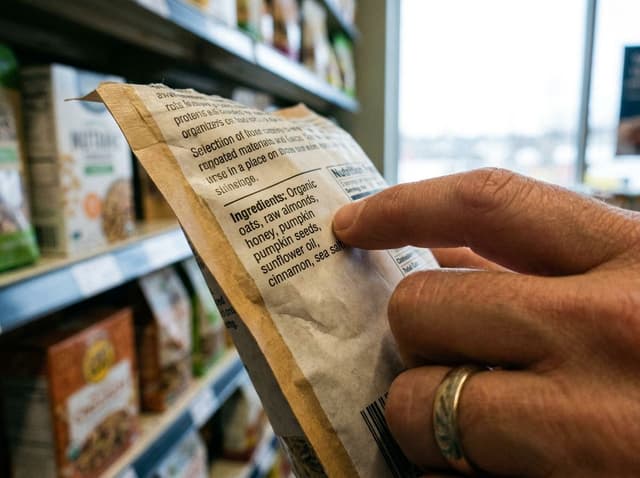
Nutrition labels are powerful tools for making informed food choices, but they are often misinterpreted. Discover the five most frequent mistakes, how to avoid them, and how Luminatens can help you read labels more accurately
Mistake 1 – Ignoring the Serving Size
Many consumers focus only on total calories without checking how many servings are in the package
- Why it’s a problem Nutrition values are listed per serving, not for the entire package
- Typical consequence A 200 g package with 2 servings of 100 g hides the fact that, if consumed entirely, it delivers double the calories, fats, and sugars
How to fix it
- Always check “Servings per container” and “Serving size” on the Nutrition Facts label
- Use Luminatens to automatically recalculate nutritional values and %DV based on the actual amount consumed
Mistake 2 – Underestimating Added Sugars
“Total Sugars” often includes both natural sugars (from fruit or milk) and sugars added during processing
- Why it’s a problem Added sugars contribute to diabetes and obesity risk, but they are not always clearly indicated
- Typical consequence A product labeled “low sugar” may still exceed your daily limit for added sugars
How to fix it
- Look for the “Added Sugars” line on the label and make sure it stays under 10% of your daily calorie intake
- Filter foods by added sugar content using Luminatens to easily compare options
Mistake 3 – Trusting “Light” or “Zero” Claims
Words like “light,” “diet,” or “fat-free” don’t necessarily mean healthier or lower-calorie products
Why it’s a problem“Fat-free” products often include added sugars, artificial sweeteners, or thickeners to compensate
Typical consequence You may consume similar calories or unwanted ingredients despite choosing the “light” version
How to fix it
- Read the complete nutrition facts (calories, carbs, total fats)
- Use Luminatens to compare the “light” version with the standard one and reveal hidden differences
Mistake 4 – Overlooking Sodium
Low-fat packaged foods can still contain high sodium levels, affecting cardiovascular health
Why it’s a problem Excess sodium raises the risk of high blood pressure and heart disease
Typical consequence A single soup or ready meal may provide 100% of your daily sodium limit in one serving
How to fix it
- Always check sodium in milligrams and its % Daily Value (%DV)
- Set a sodium threshold in Luminatens and get alerted when it's exceeded
Mistake 5 – Forgetting Micronutrients
People often focus only on calories and macronutrients, neglecting essential vitamins and minerals
Why it’s a problem A healthy diet also requires proper intake of micronutrients like vitamin D, vitamin C, calcium, and iron
Typical consequence Low-calorie foods may lack essential nutrients, leading to long-term deficiencies
How to fix it
- Check the presence and %DV of key micronutrients on the nutrition label
- Use Luminatens to view a radar chart showing your micronutrient intake compared to daily needs
Summary Table of Mistakes and Solutions
| Mistake | Why It's a Problem | Common Consequence | How Luminatens Helps |
|---|---|---|---|
| Ignoring Serving Size | Labels are per portion, not package | Underestimating calorie and nutrient intake | Automatically recalculates nutritional values per 100g for precise tracking |
| Underestimating Added Sugars | Includes natural + added sugars | Exceeding sugar limits unknowingly | Displays sugar values as provided per 100g for easier daily intake estimation |
| Trusting Light/Zero Labels | Misleading claims compensate with additives | Hidden calories or sweeteners | Allows detailed inspection of each product’s label without relying on marketing claims |
| Overlooking Sodium | High sodium in low-fat foods | Risk of hypertension | Shows exact sodium content per 100g to support better-informed choices |
| Forgetting Micronutrients | Misses essential nutrients | Long-term deficiencies | Shows all micronutrient values per 100g as provided on the label |
If you also want to know how to read food labels, check out our additional article!
Further Reading and Sources
- FDA – How to Understand and Use the Nutrition Facts Label
- Harvard T.H. Chan School of Public Health – Reading Food Labels
- CDC – Added Sugars
- American Heart Association – Sodium and Salt
- Cleveland Clinic – Micronutrients: Types, Functions, Benefits
🔍 FoodReveal helps you decode nutrition labels beyond marketing. Available for Android and iOS.